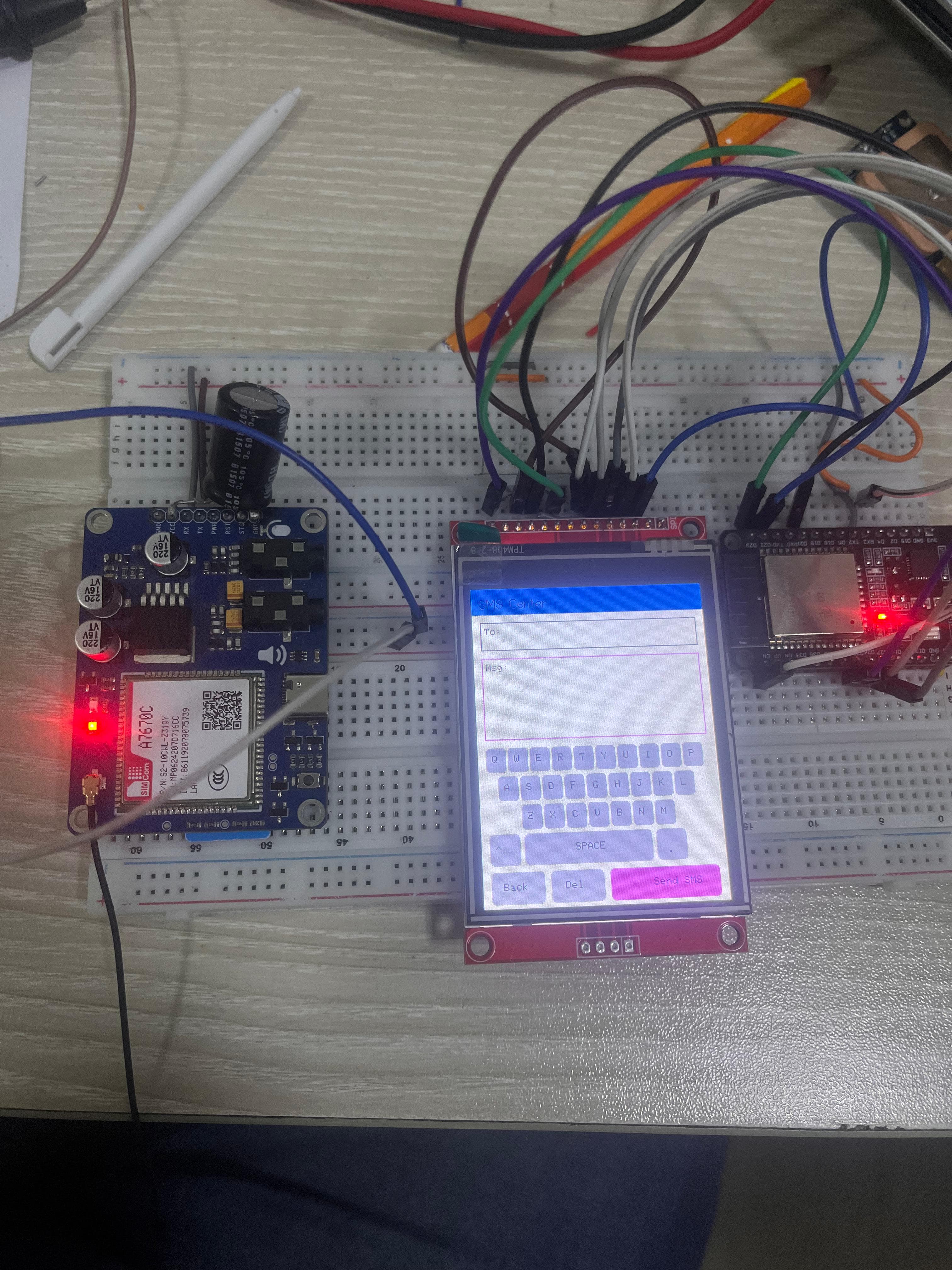
Making an A7670C 4G Module Smart Phone with Touchscreen SMS UI
Notes from building a tiny "smart phone" prototype with the A7670C 4G module, a touchscreen, a dialer and an SMS keyboard — without any phone OS underneath.
How this started
A simple question kept bugging me: how much of a phone can you actually rebuild without an Android or iOS layer underneath? Just a microcontroller, a 4G modem and a touch display. So I started this project to find out.
The cellular side is the A7670C. The interface is a touchscreen driven by an MCU. The result is a small device that walks through a phone-style menu — dialer, SMS, inbox, settings — with a full on-screen keyboard for typing messages.
Why the A7670C and not SIM800
A lot of older GSM projects (mine included, see the SIM800 post) use 2G modules. They are cheap and easy. But 2G is being shut down in more and more places, so for anything new I wanted to be on a 4G module.
LTE modules also behave differently. They draw more current in bursts, they take longer to register, and they teach you to respect the power side of the design in a way a SIM800 does not.
The UI took longer than the modem
I expected the modem side to be the hard part. It was not. The hard part was the touchscreen UI.
A phone is not "a modem plus a screen". It is a user experience around a modem. The dialer needs to feel like a dialer. The SMS keyboard needs to not get in your way. The inbox needs to be navigable with a thumb. Once you start thinking that way, you realise how much state hides behind every screen transition.
The fights I had with this build
- Power. LTE modules pull current in bursts during registration and transmission, and weak wiring is enough to make the modem reboot. I kept thinking I had a firmware bug; I had a power bug.
- Command timing. AT commands look instantaneous on paper, but real modem responses have delays, retries and edge cases. The firmware has to be patient.
- UI state. Touch input is fast; modem state changes slowly. The two need to be decoupled so the UI never feels frozen while the modem is busy.
What it does today
The current prototype can walk through the phone menu, open the dialer, write an SMS using the touchscreen keyboard and send it through the SIM. That alone made it worth building.
Where it goes next
Voice calls, contact storage, message history, an audio path, battery charging, a proper enclosure. The list is long, but the foundation is in place.
For me, this is one of my more ambitious embedded UI projects because it sits at the intersection of cellular communication and a real human-facing interface — and you can not skimp on either side.