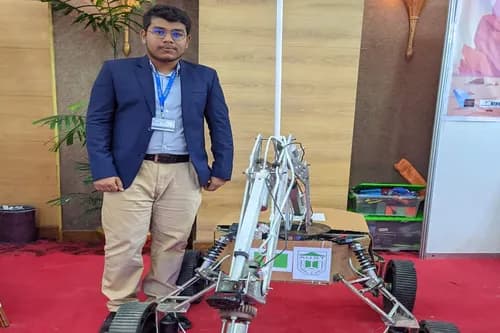
AUST Mars Rover Electronics: PCB Design and Power Distribution Lessons
Lessons from the rover electronics side: circuit simulation, PCB planning, power distribution and the kind of integration work you only learn by doing it on a real team.
A rover is not a side project
Working on the AUST Mars Rover is the project I learned the most from, mostly because nothing about it is "just electronics". There is a mechanical team, a software team, a mission plan, a deadline, and a chassis that keeps changing shape. Your boards have to live with all of that.
I led the circuit-simulation and PCB-design side — power distribution, connectors, harnesses, integration with the motor drivers and the comms subsystem.
Power distribution is half the rover
Rover electronics need clean separation between high-current and low-current sections. Motors and actuators cause voltage dips and noise. Comms and logic need stable power. A good power-distribution board is not just a connector board — it decides how maintainable and reliable the rover becomes.
I focused on connector placement, current paths, wiring reduction and clear subsystem separation. In a competition or field test, a loose connector can waste hours. The board has to be understandable by the whole team, not just the person who designed it.
How I approach rover PCBs
For rover boards I prefer practical layouts. Labels are readable. Connectors face useful directions. Test points exist where debugging is likely. Power traces are sized for real current. Grounding is planned, not random.
Simulation helps, but the field is the real test. Vibration, dust, moving wires and quick repairs all influence the design.
What I really learned
Rover electronics is systems engineering. Motor driver choice affects battery selection. Connector choice affects mechanical assembly. Module placement affects antenna performance. Power board design affects firmware stability.
In a university team with limited resources, the goal is not to build the fanciest board. The goal is to build something that can be tested, repaired and improved.
What I take from the project
The rover work made me much more confident in PCB design, subsystem planning and team coordination. It is one of my favourite robotics experiences because it makes electronics feel small inside a much bigger system.