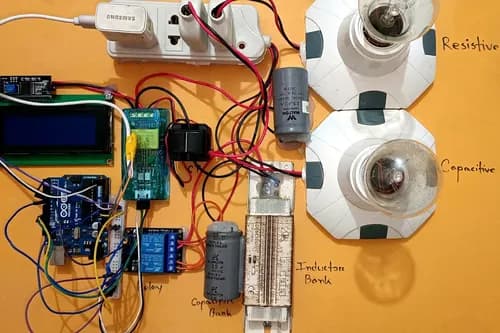
Automatic Power Factor Corrector: Real-Time Capacitor Bank Switching
Why I built an automatic power factor corrector with capacitor-bank switching, and what I learned about measurement, relay timing and AC safety on the way.
The quiet problem of low PF
Low power factor is a sneaky problem. AC loads — especially motors and inductive equipment — push the current up, create extra losses, and in industrial billing they can turn into real penalty charges.
I built an automatic power factor corrector to understand the whole loop from measurement to control. The device watches the load, picks the right capacitor stages, and switches them in through relays to bring PF closer to unity.
Measurement and correction
The system needs voltage and current. From there the controller estimates the load behaviour and decides how much capacitive correction is needed. The capacitor bank is split into stages, and relays bring stages in or out.
Staged correction beats one fixed capacitor every time — it can respond to actual load changes.
Firmware behaviour
The firmware reads the measurements, calculates how much correction is needed, picks relays and updates the display. The most important detail is timing. Switch too fast and the relays chatter, wearing out the contacts.
So the logic includes delay, hysteresis, and stability checks. Power systems are not buttons. They reward patient decisions.
Hardware lessons
Capacitor switching on AC needs safety thinking. Discharge paths, relay ratings, isolation, fuses and proper enclosure design all matter in a real product. As a prototype, my main goal was learning how to combine sensing, decision and switching.
The display is also a teaching tool. People can see PF improving live, instead of having to take my word for it.
Why this project still matters to me
It is one of the cleanest examples I have of classroom power theory meeting a working embedded device. It is also genuinely useful for small factories, workshops and labs where electrical efficiency makes a difference.
Future steps: a dedicated metering IC, RMS calculation, Modbus communication, data logging and a safer industrial enclosure. The corrector is a good demonstration of how an embedded system can quietly improve power quality without needing anyone to think about it.