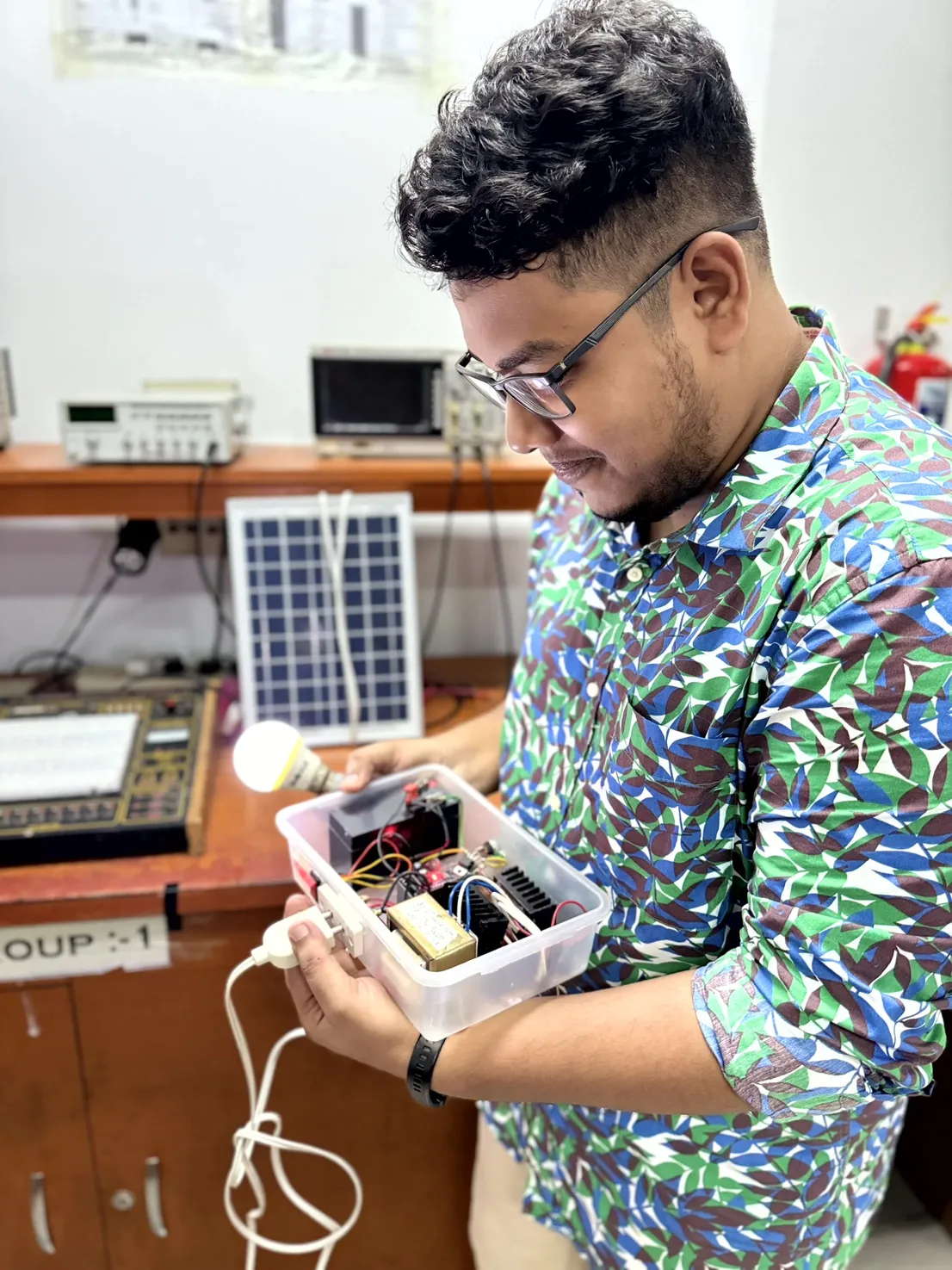
Pure Sinewave Inverter with Solar Charging for Backup Power
My thesis project as a real device: a pure-sinewave inverter with solar charging, aimed at the kind of hybrid rural power setups my work was about.
Why I care about inverters
Reliable power is still a real problem in many parts of Bangladesh. For rural homes, small shops and student labs, a good backup system can change the entire day. My pure-sinewave inverter with solar charging started from that very practical need.
The system combines battery storage, solar input and DC-to-AC conversion. The goal is a cleaner AC output than a typical square-wave inverter, plus support for renewable input — exactly the kind of architecture my thesis on hybrid rural power was about.
The SPWM idea
A pure-sinewave inverter usually uses SPWM. The controller generates switching pulses that, after filtering and the transformer, approximate a sine wave. That is much better for sensitive appliances than rough square-wave output.
The main hardware blocks are the switching stage, transformer, driver circuit, battery input and solar charging section. Every block needs care — power-electronics failures are not subtle.
Solar makes it real
Solar makes the project meaningful for the region. A battery backup that recharges from sunlight is genuinely useful where grid power is unreliable. The charging side needs proper voltage and current control. A future version should add MPPT for better panel utilisation.
What was hard
Heat, switching losses, waveform quality and protection were the big ones. A small mistake in gate drive or wiring can kill MOSFETs in milliseconds. Battery protection also matters — over-discharge and over-charge both eat battery life.
This project taught me that power electronics rewards slow, careful testing. Control signals first. Low-voltage behaviour next. Power stage after that. Loaded testing last.
What is next
Closed-loop voltage feedback, LC output filtering, thermal shutdown, overload protection, LCD monitoring and a proper metal enclosure.
For me, this project is one of my more advanced builds because it combines renewable energy, embedded control and high-power hardware. It is not just a demo — it is the shape of a real backup-power product for the kind of users I actually want to design for.