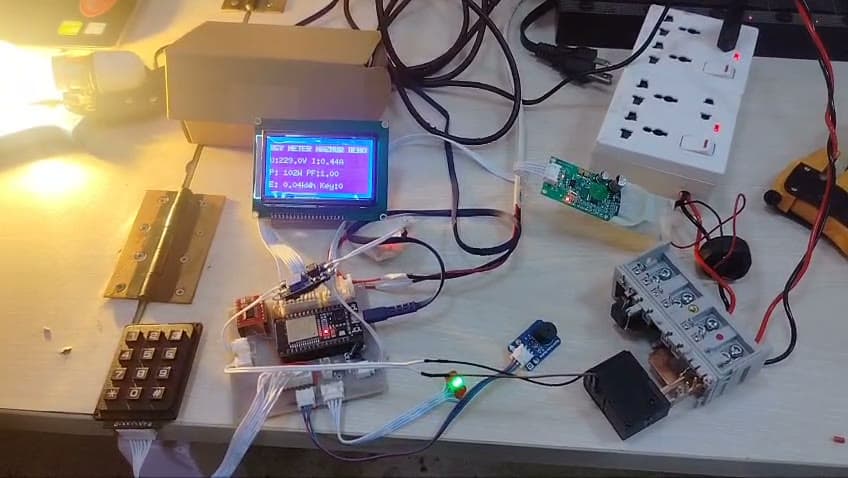
Smart Energy Meter Load Controller with LCD, Keypad and Relay Output
A practical look at a smart energy meter and load controller I built — live readings on an LCD, keypad input, a real relay, and the safety reminders that come with mains power.
Why I keep building energy projects
Power feels close to home in Bangladesh. Bills, load shedding, backup supplies, unsafe wiring, appliances dying after a voltage dip — these are not abstract problems. They live in everyone''s house.
So when I picked a project to work on, an energy meter and load controller felt like the obvious one. The idea: measure, display, and control. Three small things; three useful things.
The system on the bench
The controller reads voltage, current, power and energy from a measurement stage. The LCD shows the values live. The keypad takes user input. A relay or load-control board switches the connected load.
It is a bench prototype, but the same architecture can grow into prepaid metering, lab load monitoring, remote appliance control or a small industrial energy dashboard.
The firmware juggle
The firmware is doing several things at once: reading measurement values, updating the display, scanning the keypad and controlling the relay. If the display refresh is too slow, the user does not trust the meter. If the relay control is careless, the load switches at the wrong time.
Good structure matters here. Measurement, UI and control should be cleanly separated even if they all live on the same microcontroller.
A safety reminder I owe the reader
Anything connected to mains deserves respect. Bench wiring is fine for testing but a real product needs proper isolation, fuses, an enclosure, strain relief and clear separation between the low-voltage and high-voltage sides.
This project reminded me that power electronics is not only about getting the circuit to work. It is also about making it safe enough that someone else can use it.
Where it is going
Wireless telemetry, data logging, a mobile dashboard, a prepaid-style mode, a calibration menu and a proper enclosure. The dream version would be a small unit that a shop owner could install themselves and actually understand their usage from a phone.
For me, the strength of this project is its direction. It combines measurement, UI and control into one device — exactly the kind of embedded system that can solve very practical local problems.