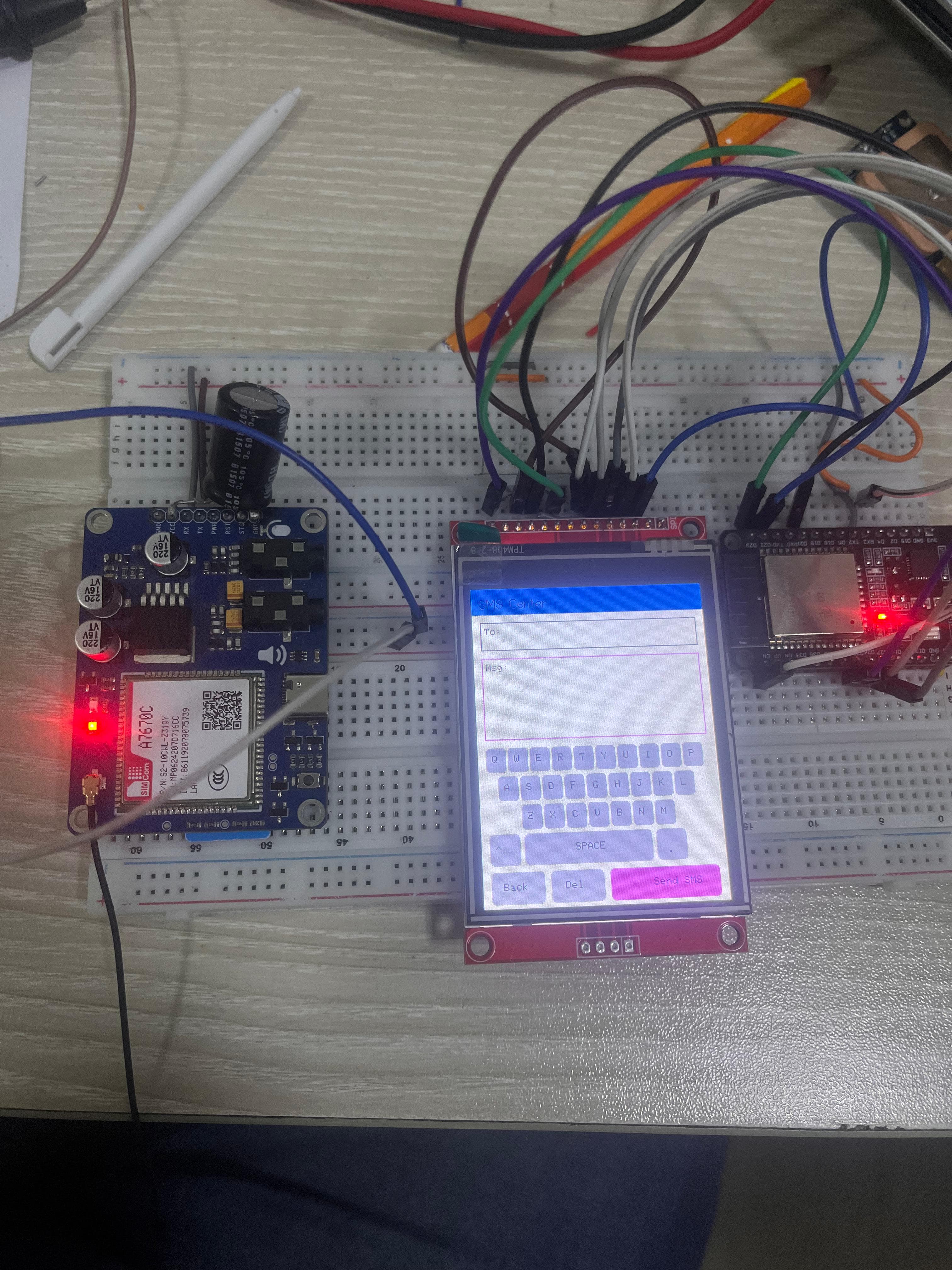
A handmade "smart phone" prototype around the A7670C 4G module, with a touchscreen dialer, SMS keyboard and inbox.
Overview
I wanted to know how much of a real phone you can recreate without any phone OS — just a microcontroller, a 4G module and a touch display. The A7670C felt like the right place to start because 4G is going to outlive 2G in most networks here.
The controller drives a touchscreen that walks through a phone-style menu: dialer, SMS, inbox and settings. SMS even has a full on-screen keyboard, which makes the prototype feel less like a modem test and more like a tiny device you could imagine carrying. Underneath, the MCU talks to the A7670C over UART using AT commands.
It is still very much a prototype, but it taught me a lot about how much state hides behind something as simple as "press send".
Touchscreen UI collects user actions, the controller translates them into modem commands, and the A7670C module executes cellular functions such as SMS and network operations.
Project photos
SMS center with touchscreen keyboard and send button.
Retro phone menu with dialer, SMS, inbox, and settings.
Implementation details
Firmware
Firmware presents a phone-like menu, handles touch input, builds SMS text through an on-screen keyboard, and communicates with the A7670C module using AT commands for cellular functions.
Power
Powered from a bench supply during prototyping, with attention to the high transient current required by cellular modules during network registration and transmission.
Components / BOM
A7670C 4G module, ESP32-class development board, Touch TFT display, SIM card, Power supply and wiring
Engineering challenges
Cellular modules are hungry, especially during registration and transmission. Anything weak in the power path makes the modem brown out and look like the firmware is broken. The other tricky part was keeping the UI state and modem state in sync when the network is slow.
Solutions
I separated the phone-style UI from the AT-command layer, so the screen could stay responsive while the modem was busy. The SMS keyboard ended up as its own screen with proper state handling instead of being squeezed into the inbox.
Results & metrics
Demonstrates a working phone menu, dialer screen and an SMS keyboard sending real messages over a SIM.
Future improvements
Add voice calls, a contacts list, persistent SMS history, audio path, battery charging, and finally a compact enclosure so it stops looking like a science fair project.